Why I Built OnRamp: Finding Where App Users Get Stuck
You can put a lot of work into an app, launch it, and still have one basic question you cannot answer confidently: what happens between someone signing up and actually getting something useful out of it?
Downloads tell you that someone was interested. A signup tells you they were willing to try. Neither tells you whether they reached the moment that makes the app worth keeping.
That gap is the problem I'm working on with OnRamp, an analytics platform for mobile and web apps.
The question behind OnRamp
When an app's growth slows down, it's tempting to look for more traffic. More posts, more ads, more installs.
But what if the people already arriving cannot get through the first few screens?
Imagine a fitness app where people create an account, begin setting up their profile, and then leave before logging their first workout. The total signup count could look encouraging while the experience that matters is failing.
You could shorten every screen and hope something improves. Or you could measure the journey and find the transition that needs attention.
I'm building OnRamp around that second approach: make the next product decision easier by showing where people stop moving forward.
Start with the moment your app becomes useful
Before choosing events to track, I think it helps to decide what a successful first visit looks like.
For an expense-sharing app, that might be creating a group and adding the first expense. For a writing app, it might be saving the first note. For a fitness app, it might be completing the first workout.
Then work backwards. What does someone need to do to reach that moment?
A simple journey might be:
App opened → Account created → Profile completed → First useful action
The exact steps depend on the product. The point is to measure meaningful progress, rather than treating every tap as equally useful.
OnRamp lets you track those milestones and define an onboarding funnel in the dashboard. You can then see how many people reach each step and where the biggest loss occurs.
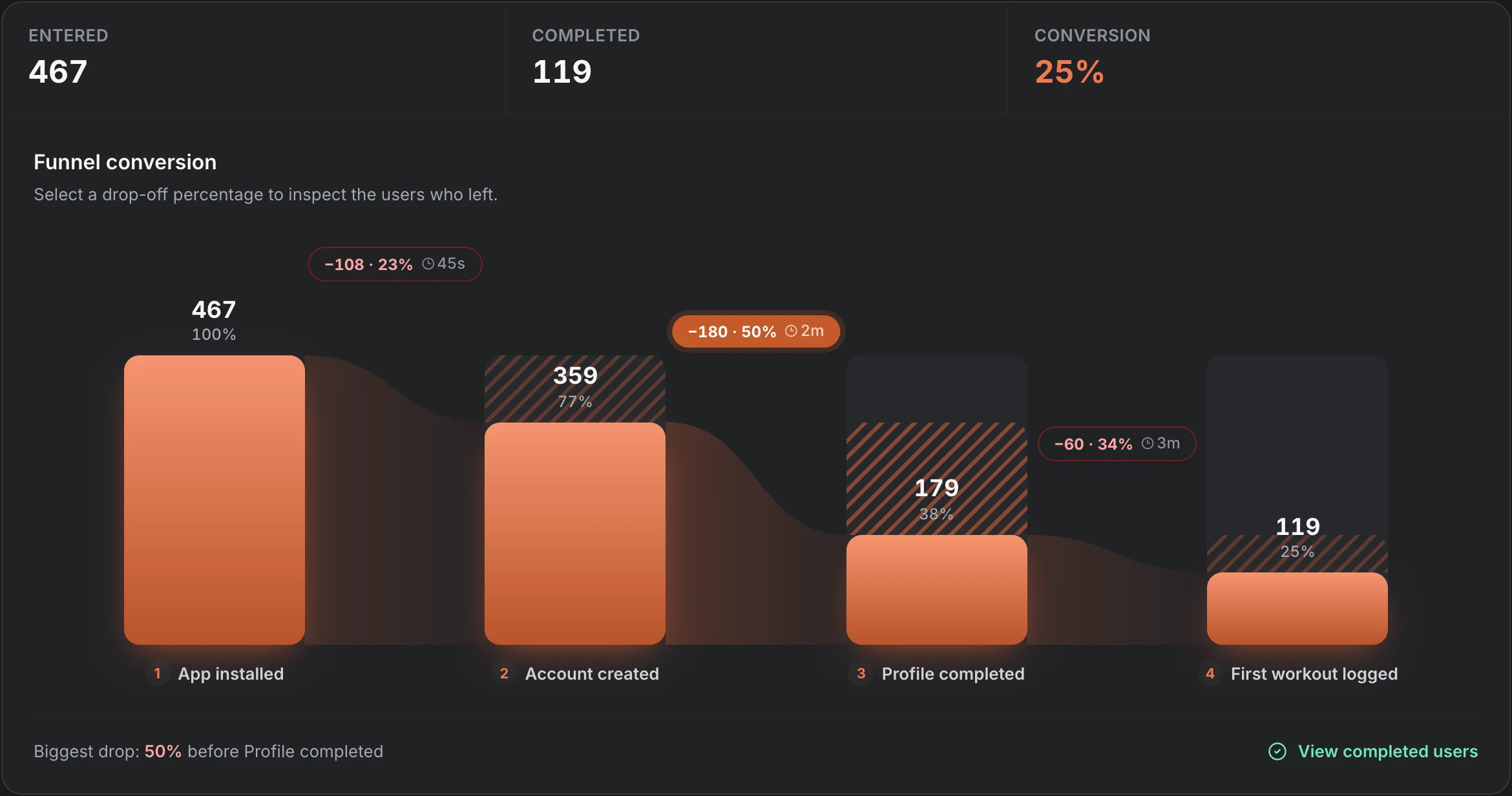
OnRamp's funnel view. Sample data illustrates the workflow; these figures are not a customer result.
A drop-off tells you where to investigate
If a funnel shows a large loss before profile completion, that is a useful starting point. It still leaves an investigation to do.
Perhaps the form is confusing. Perhaps the next screen fails to load. Perhaps the app asks for too much before explaining why it is worth continuing.
OnRamp provides breakdowns by device and app version, alongside event-based user journeys. That helps you ask more specific questions: does the problem appear after one release? Is it concentrated on one kind of device? What was the last recorded action before someone left?
The events give you evidence about behaviour. User feedback and testing help explain the reason behind it.
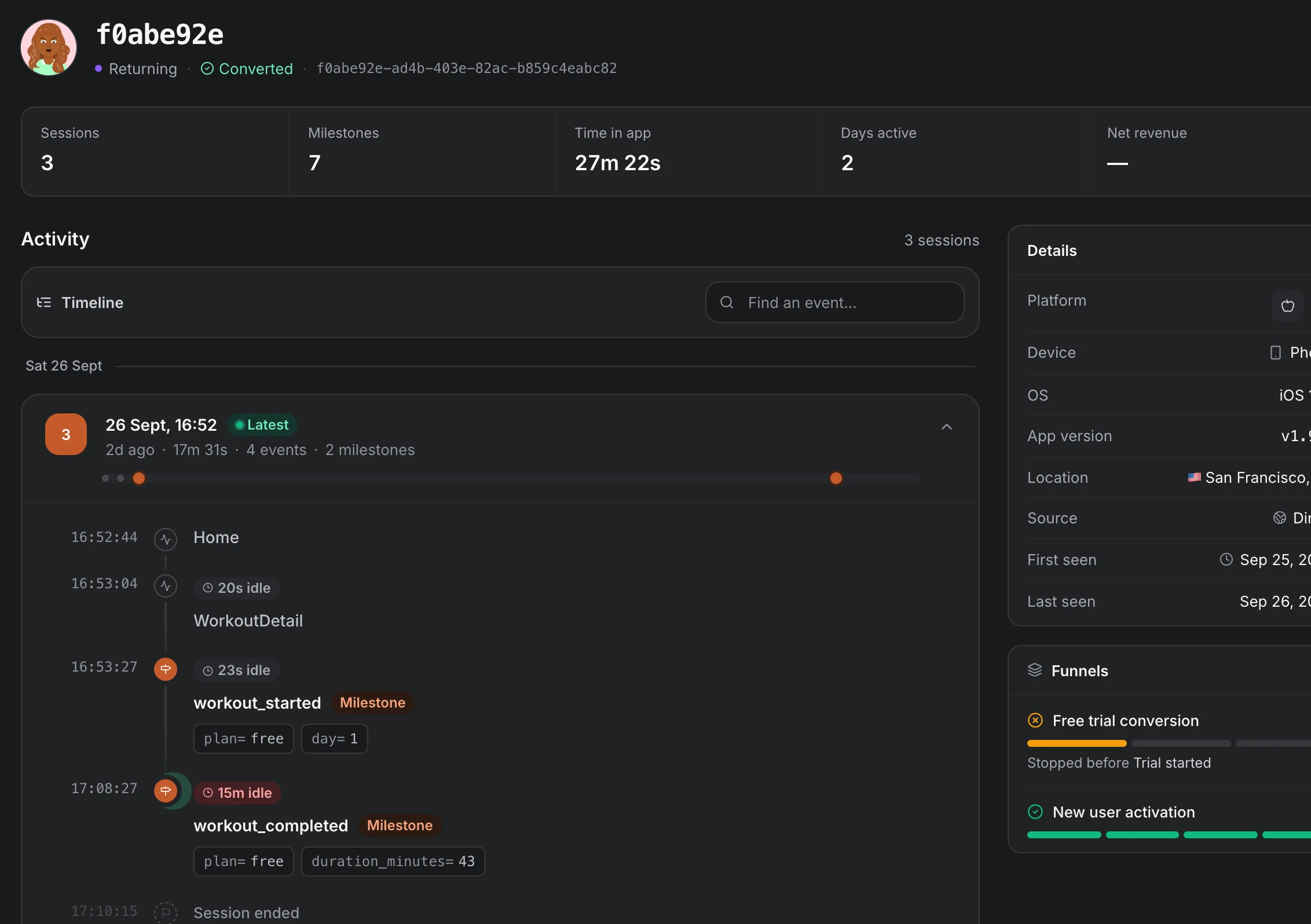
An example user journey in OnRamp. The timeline uses recorded events, without recording the user's screen.
A concrete example: Splitr
The published Splitr onboarding case study shows why a specific transition matters.
In the earlier app version, 110 users completed signup, but only 10 completed club creation. The analysis identified the handoff immediately after signup as the main place users were getting lost.
After focused onboarding changes, a later cohort had 50 completions out of 140 users: roughly 36%, compared with 9% before.
Those were different release cohorts, rather than a randomized experiment, so the comparison does not prove that one change caused the entire improvement. It does give a concrete example of turning a broad growth concern into a focused product investigation.
Getting started without tracking everything
My suggestion is to begin with one journey and a small number of milestones. Track the path to your app's first useful action, verify the events, and build a funnel from those exact event names.
OnRamp has SDKs for React Native, Expo, Flutter, native iOS with Swift, React, Next.js, and web projects. The setup guide walks through installation, initialization, milestone tracking, and creating the funnel.
Once you have a baseline, investigate the largest drop-off, make a focused change, and compare the next release. Then check whether the users who get through onboarding come back. Completion is useful when it leads to lasting value.
What I'm trying to build
I want OnRamp to help app builders answer a practical question: what should I improve next?
Sometimes the answer will be a clearer next step. Sometimes it will be a bug in one version. Sometimes the flow will work, but the app will need to explain its value earlier.
If you're building an app and wondering where people disappear after signup, explore OnRamp's public demo. It is a way to see the funnel and journey views before instrumenting your own app.
The goal is to help more people reach the part of your product you worked so hard to build.